
Updated January 2nd, 2024
Are you looking for an easy guide on how to start a blog?
The step-by-step guide on this page will show you how to create a blog in 20 minutes with just the most basic computer skills.
After completing this guide you will have a beautiful blog that is ready to share with the world.
This guide is made especially for beginners. I will walk you through each and every step, using plenty of pictures and videos to make it all perfectly clear.
If you get stuck or have questions at any point, simply send me a message and I will do my best to help you out.
Ready to start? Click here to skip the intro and start building your blog now
My name is Scott Chow, and I am going to show you how to start blogging today. I have been building blogs and websites since 2002. In that time I have launched several of my own blogs, and helped hundreds of others do the same.
I know that starting a blog can seem overwhelming and intimidating. This free guide is all about blogging for beginners, and will teach you how to become a blogger with just the most basic computer skills. So whether you’re 8 or 88, you can create your own blog in 20 minutes.
I am not ashamed to admit that when I was first learning how to build a blog I made a ton of mistakes. You can benefit from more than a decade of my experience so that you don’t repeat these same mistakes when you make your own blog. I created this free guide so that a complete beginner can learn how to blog quickly and easily.
So, just how do you start a blog?
Learn how to create a blog in about 20 minutes following these steps:
How to Start a Blog in 6 Steps
- Pick a blog name. Choose a descriptive name for your blog.
- Get your blog online. Register your blog and get hosting.
- Customize your blog. Choose a free blog design template and tweak it.
- Write & publish your first post. Share your thoughts with the world. The fun part!
- Promote your blog. Get more people to read your blog with the proper marketing.
- Make money blogging. Choose from several options to monetize your blog.
Should you start a blog?
One of the misconceptions about starting a blog is that you need to be a great writer to be successful. Nothing could be further from the truth. People read blog sites to get a personal perspective on things, so most bloggers write in a very informal and conversational style.
And because of the format, many successful bloggers will write about a variety of topics on the same blog.
In addition, you don’t need to be an expert on any of the topics you write about to have a successful blog. For example, visitors to a cooking blog don’t want to read a textbook from a food scientist, they want to hear the experiences of someone who has actually cooked some real meals, mistakes and all.
To be successful as a blogger there is really just one requirement: a passion for your topic.
At its heart, blogging is about sharing your knowledge with the world. Writing about things that you are passionate about makes the process of starting a successful blog so much easier. As long as you are writing about things that you are genuinely interested in, your passion will shine through and keep your visitors interested.
So why would you go to the trouble of blogging? There are a few reasons:
- Share your story. A blog allows you to have a voice and be heard. You can share your story with the entire world if you so choose. One of the most common ways blogs are used are as a diary where the blogger writes about their daily experiences so that friends, family, and others can all be a part of their lives.
- Make money from home. Blogging can be quite lucrative if done correctly. The top bloggers in the world obviously earn quite a bit, but even a part-time blogger can expect to make a nice profit if things are done correctly. The best part about it is that blogging is a form of passive income, since you can spend just a few hours a week writing a piece of content and then continue to profit from it long after the the writing is finished. I go into much more detail on how to blog for money later in this guide.
- Recognition for yourself or your business. No, you probably won’t have paparazzi following you around because of your latest post. But a successful blog makes your idea into a reality, and can gain you a ton of recognition in your respective field. Many bloggers are known as experts just because of their blogs, and some have even gotten book and movie deals based on their blogs.
- Find a community. Blogging at its heart is interactive. You write a post and people comment on it. This is a good way to connect with people who are interested in the same things as you are. Blogging allows you to teach these people based on your experience, and it gives you the opportunity to learn from your readers as well.
Ready to begin? Click here to go to Step #1 of the guide
What is a blog anyway?
In short, a blog is a type of website that focuses mainly on written content, also known as blog posts. In popular culture we most often hear about news blogs or celebrity blog sites, but as you’ll see in this guide, you can start a successful blog on just about any topic imaginable.
Bloggers often write from a personal perspective that allows them to connect directly with their readers. In addition, most blogs also have a “comments” section where visitors can correspond with the blogger. Interacting with your visitors in the comments section helps to further the connection between the blogger and the reader.
This direct connection to the reader is one of the main benefits of starting a blog. This connection allows you to interact and share ideas with other like-minded people. It also allows you to build trust with your readers. Having the trust and loyalty of your readers also opens up the door to making money from your blog, which is something I discuss later in this guide.
The good news is that the internet is exploding with growth right now. More people than ever are online. This explosion in growth means more potential readers for your blog. In short, if you are thinking about starting a blog then there is no better time than right now.
Let’s start your blog!
Step 1: Pick a blog name
If you are not sure what to name your blog, or what topic to blog about, skip to the next section.
If you’ve already got an idea for the name of your blog, you can check to make sure that no one else has already registered it:
See if your blog name is available:
Note: You cannot use any spaces or punctuation other than dashes in a domain name.
If you find that the name you wanted is already taken there are a few things you can do:
- Try a different domain extension. If the .com version is already registered you may still be able to get the .net or .org version of the name.
- Add small words. Words like “a”, “my”, “best”, or “the”. For example, this site is called TheBlogStarter.com instead of BlogStarter.com.
- Add dashes between words. For example, scott-chow.com
How to Choose a Blog Topic & Name
If you don’t have an idea for a name already, the first step is choosing your blog topic.
If you’re not sure what to blog about, there are a few ways to find a good blog topic:
- Life experiences. Everyone has lessons they have learned through life experience. Sharing this knowledge can be incredibly helpful to others in similar situations.
For example, I recently helped a woman start her blog about being a fireman’s wife. She has a lot of experience and knowledge to share with others about this topic, and it has helped her connect with others in similar situations.
Think about the things you have experienced in life. This could be related to your family (example: a blog about being a stay at home mom), work (a blog about experiences dealing with clients), or other life experiences (a blog about dealing with a troubling time such as a disease or divorce, or about a happy time such as preparing for a wedding or a birth of a child). - A personal blog. A personal blog is a blog all about you. This will include a variety of topics, from things you do on a daily basis, to random thoughts and musings. This is a great way to share your thoughts with the world without having to stick to just one topic.
- Hobbies & passions. Hobbies or other interests you are passionate about are a great place to start. Cooking, travel, fashion, sports, and cars are all classic examples. But even blogs about more obscure hobbies can be successful, since the your audience is literally anyone in the world with the internet.
Once you have a topic it’s time to choose your blog name, also known as your domain name.
A good blog name should be descriptive so that potential visitors can instantly tell what your blog is about just from the name.
If you are blogging about one specific topic then you will definitely want to include that in some way when you pick a domain name. Try not to get hung-up on just one word though. For example, a cooking blog doesn’t necessarily have to have the word “cooking” in it. The words “food”, “recipes”, and “meals” would also let people know that your blog is about cooking.
If you are planning to create a personal blog where you discuss a variety of topics then I recommend using your name, or some variation of it, since your blog is all about you. For example, I own the blog scottchow.com. You can also add your middle name or middle initial if you find your name is already taken. Or you could use a variation like “Scott Chow Blog” or “Blogging with Scott”.
Can’t decide on a good name for your blog? Contact me and I will help you personally (for free)!
Once you have some name ideas you will need to choose a domain extension.
A .com domain extension is the most preferred, but .net or .org work as well. It is also important to note that for the purposes of a blog domain you cannot have any spaces between words. So “Blogging with Scott” becomes bloggingwithscott.com
Step 2: Get your blog online
Now that you’ve got a name picked out it’s time to get your blog online. This might sound hard or technical, but the steps below will walk you right through and make the process easy.
 To get your blog up and running you need two things: blog hosting (also known as web hosting) and blogging software. The good news is that these typically come packaged together.
A blog host is a company that stores all of the files for your blog and delivers them to the user when they type in your blog name. You must have a blog host in order to have a blog.
You also need to have the software to build your blog. In this guide I will be showing you how to build a blog using the WordPress blogging software, because it is the most popular, customizable, and easiest to use.
The web host I recommend, and the one I show you how to use in this guide, is BlueHost. I personally use BlueHost and I recommend them for all new bloggers because:
- They will register your custom domain name for free, making sure no one else can take it.
- They have a 30 day money back guarantee if you are unsatisfied for any reason.
- They offer a free, automatic installation of the WordPress blogging software (which I show you how to use in this guide).
- They offer reliable web hosting that has been recommended by WordPress since 2005 and they currently host over 2 million blogs and websites.
- They have helpful 24/7 customer service via phone or web chat.
Use any BlueHost link on this site to get the special discount price of $2.75 per month.
Disclosure: BlueHost compensates The Blog Starter when you purchase through this link, so my services are free of charge to you! In fact, if you have any trouble at all setting up a blog with this tutorial, just contact me and I will do it for you (free!).
1. Click here to get the special $2.75 per month rate on BlueHost and then click “get started now”.
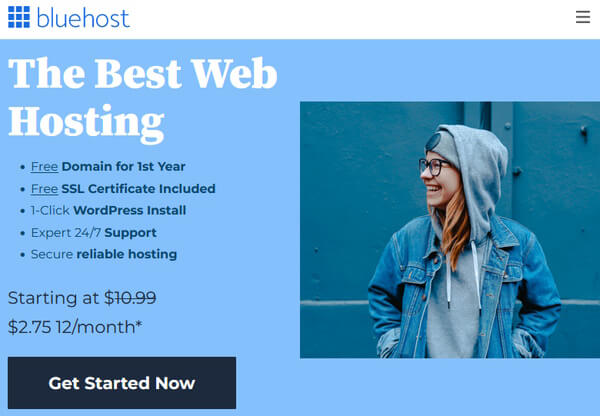
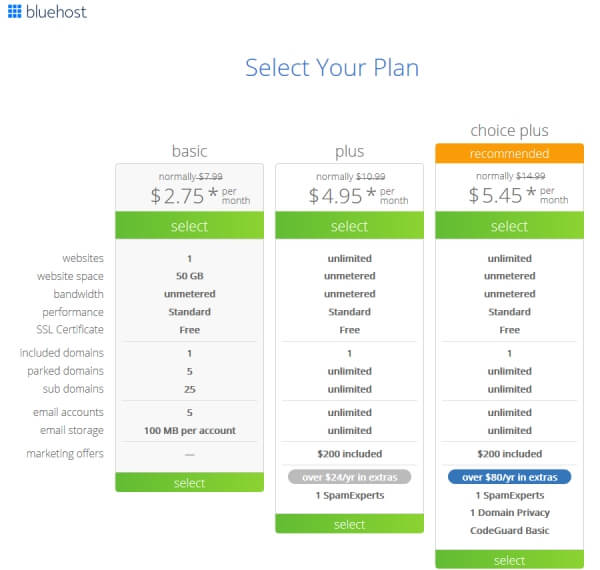
2. Select your plan. I recommend that beginning bloggers get the basic plan. Click “Select” to choose your plan.
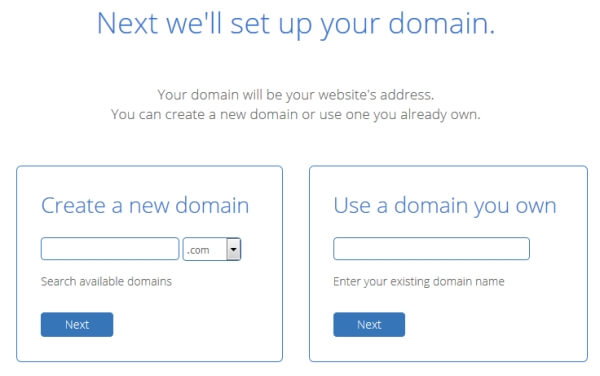
3. Type in your domain name in the left box and then click “next” to start the registration process.
- If you already own a domain name and want to use it for your blog, type your existing domain in the right box and then click “next”. Only use the right box if you have previously paid to register a domain!
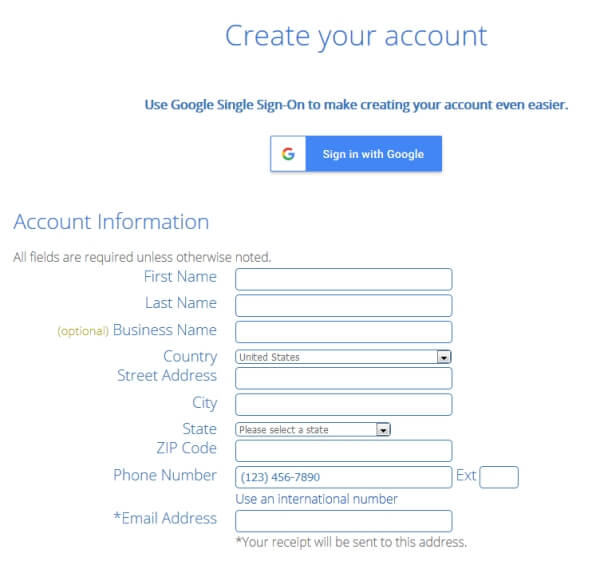
4. Fill out your billing details on the registration page.
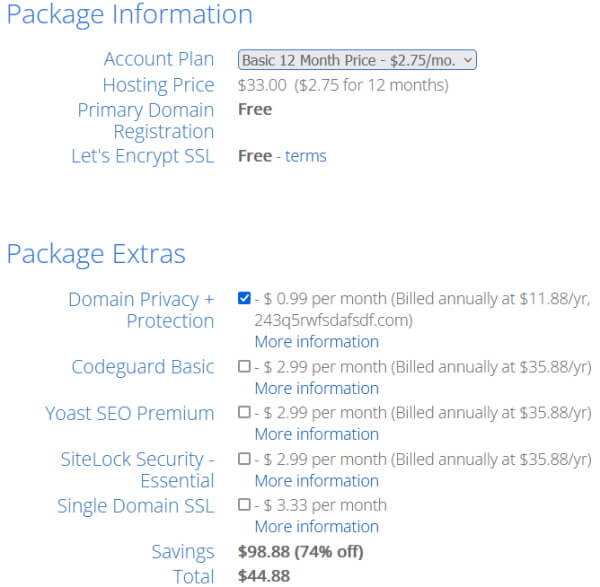
5. You will also need to choose your hosting package and options.
- Every BlueHost account plan has everything you need to get your blog up and running, including a free custom domain name, easy WordPress installation, web hosting, and custom email addresses (e.g. yourname@yourdomain.com).
- I uncheck the boxes next to the package extras except for “Domain Privacy & Protection”. While not strictly necessary, domain privacy keeps your personal information (name, address, phone, email) hidden from the public database of registered domain owners.
6. You will then need to create your BlueHost account and password.
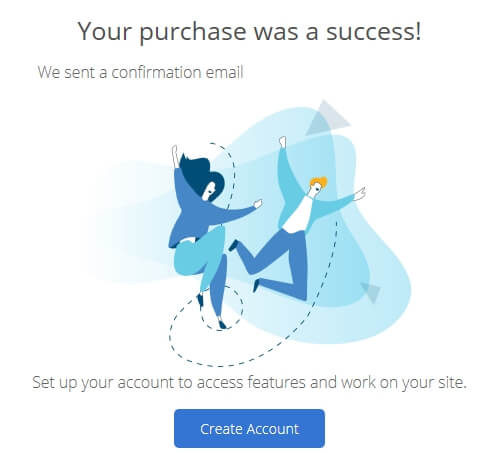
Once you do that you will be taken to an installation helper. Since you are following this tutorial you can just click “Skip this step” on the next few pages to be taken directly to the dashboard.
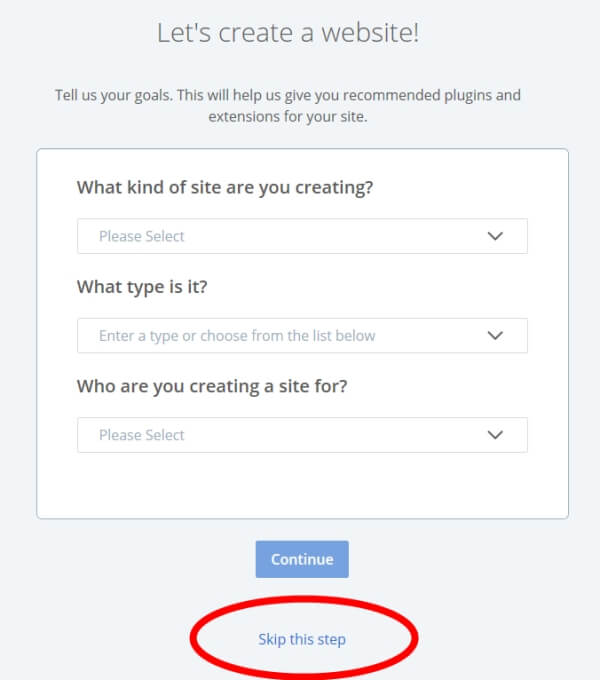
7. Install the WordPress blogging platform.
Now the system will install WordPress automatically. Once the install is complete click the “Log into WordPress” button on the top right to be logged-in to the administrator area of your blog.
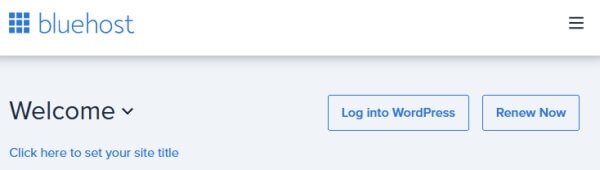
Having trouble installing your blog? Get help here.
Step 3: Customize your blog
How do I start a blog? You can watch me build and customize a beautiful blog from scratch here:
The video above should answer a lot of questions you might have about how to set up a blog and get it customized. Here is a step-by-step break-down of some of things I show in the video.
Logging in
If you are not already logged-in from the previous step, go to Bluehost.com and click “Login” on the top right to bring up the login screen. You can then login using your domain name and the password you set in the previous step. If you have misplaced your password you can reset it by clicking the “Forgot Password” link.
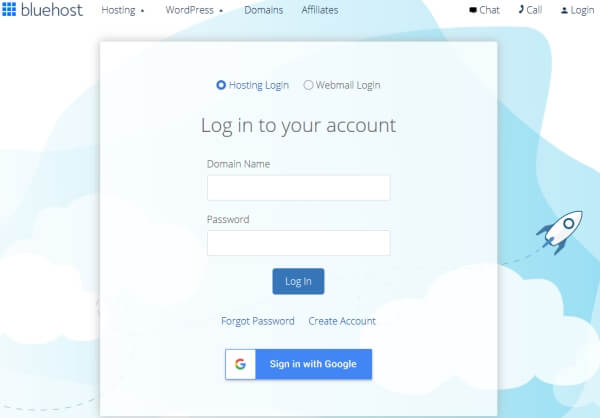
Once you log-in you will be taken to your BlueHost Portal. From the portal you can click the blue “WordPress” button to be logged-in automatically to your WordPress blog.
Changing your blog design
Once you login you will be in the WordPress dashboard. This is where you can make any changes you want to your blog.
Everyone has a different idea of how they want their blog to look. One of the great things about WordPress is that you can change your entire layout and design with just a few clicks.
In WordPress, blog layouts are known as “Themes”. What is a blog theme? Themes control the entire design of your WordPress blog. To change your theme you are going to click on the “Appearance” tab on the left menu.
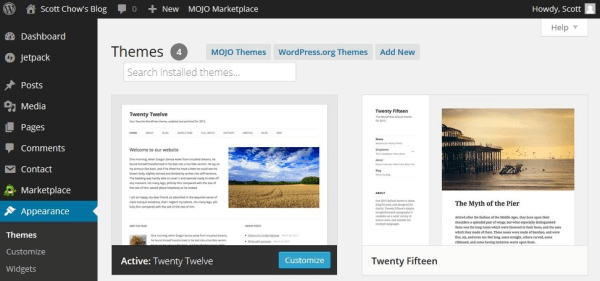
You will see several free WordPress themes are already installed on your blog: Twenty Seventeen, Twenty Sixteen, etc. These are well-designed, clean-looking themes that can work for just about any type of blog. In fact, many of the world’s top bloggers use one of these themes.
Unless you have a very specific design in mind for your blog, I suggest you use one of these themes to start with. For our example, let’s use the “Twenty Sixteen” WordPress theme. In order to activate the theme on your blog, hover over the theme and click the “Activate” button. That’s it! You have changed the entire design of your blog with just one click!
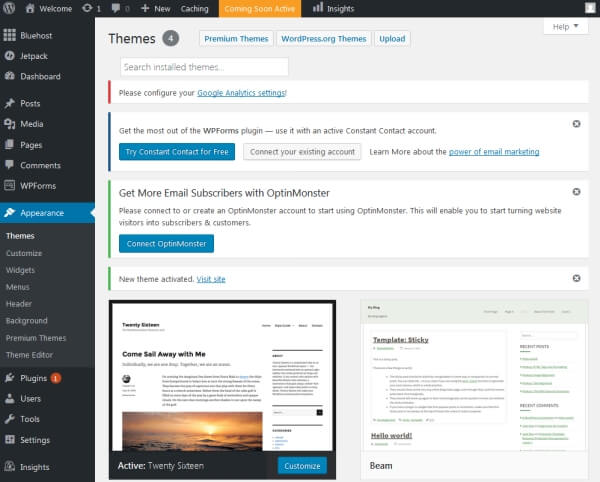
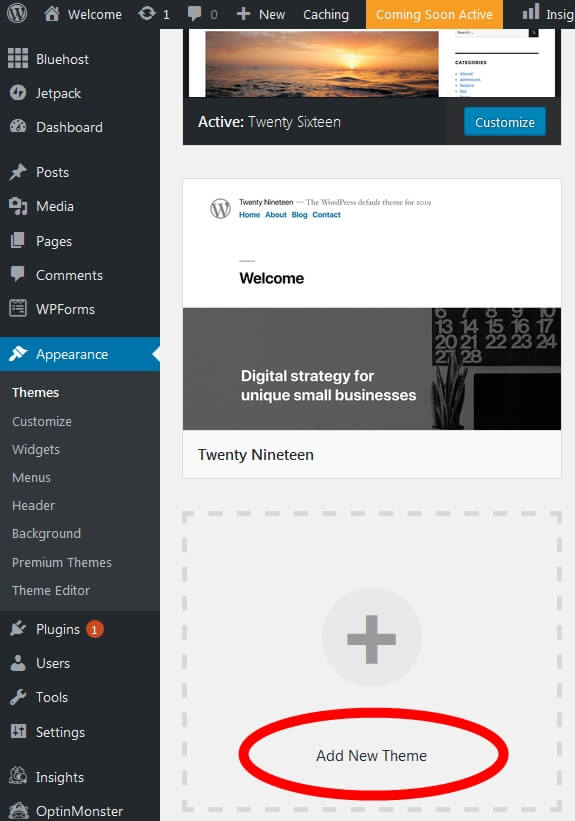
If you don’t like any of the themes that are already installed you can easily choose from thousands of other free WordPress themes. To install a new WordPress theme, click on the “Appearance” tab on the left menu and then click “Add New Theme”.
This is the WordPress theme search screen. There are thousands of themes to choose from. You can change your entire design at anytime simply by activating a new WordPress theme. To find a theme you like, I suggest you click on the “Popular” tab and start browsing. When you find one that you like click the blue “Install” button.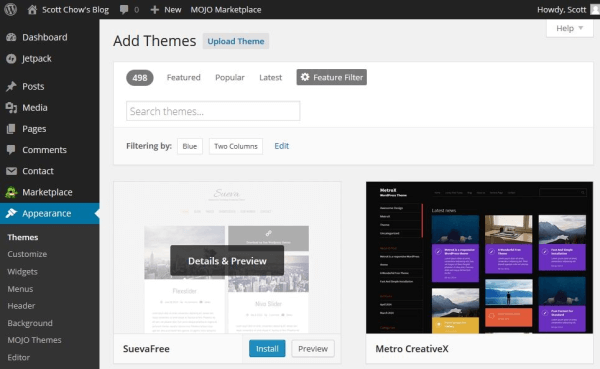
Once the theme is installed click “Activate” to activate the theme on your blog. To see your new theme in action, go to your blog and take a look!
Changing your theme is the simplest way to customize your WordPress blog, but there are lots of other customizations you can do. Check out my full post on customizing your WordPress blog for an in-depth step-by-step guide. You can also watch the video above to see me completely customize a WordPress blog from scratch.
Step 4: How to write a new blog post & publish it
Now that your blog is up and running it’s time to actually do some blogging! Let’s create your first piece of content.
Go to the left menu and click on “Posts”.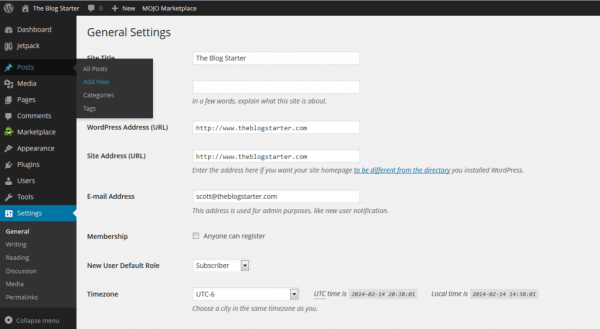
You will see there is already a post there. This is a default post on every new WordPress blog, and we don’t need it. To delete it click “Trash” just under the post.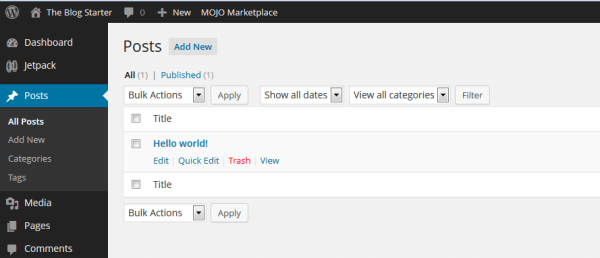
To begin writing a new post, click the “Add New” link.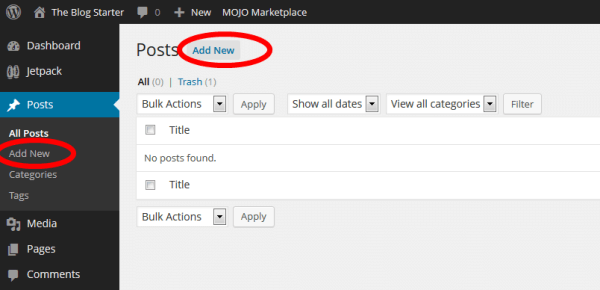
You are now on the post editor screen. Enter the title of your post in the top box and then begin writing your post in the lower box.
If you would like to add a picture to your post, click on the “Add Image” icon and click “Upload” to upload a picture from your computer. You can make adjustments to the picture size on the next screen. When you are ready click “Insert into post” to add the picture.
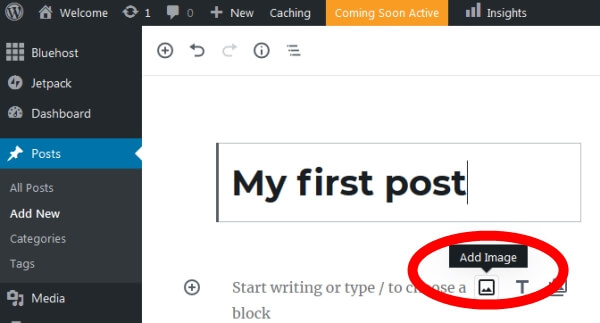
Once you have finished your post just click the “Publish” button on the top right side of the screen to publish the new post.
Content That Should be on Your Blog
There are two main types of content your blog should provide: static and dynamic content.
Static Content: Your blog should contain a few necessary pages explicitly designed to provide the visitor with the tools they need. The content on these pages is static, meaning – the content doesn’t change, or at least not very often. These are mainly top-level pages that can be accessed via a menu on your blog.
These static content pages should be in place well before you launch your blog to the world.
Important static pages to include:
- About Me (Us) – This page should include a biographical summary of the author(s) as well as a mission statement. Think about the answers to these questions: How did your passion for the subject matter develop? What do you want to convey to the world? What is your ultimate goal?
- Contact Me (Us) – A contact page provides the visitor a place to reach the author which, in turn, provides the visitor with the reassurance that you are a real and reachable author. You can add your physical address, phone number, and custom email address. Or you can utilize a simple contact form to keep your personal identifying information private. You should put links to all of your social media profiles here as well.
Aside from your blog, which is generally introduced on the home/main page, these two all-important pages should be visible on your top (header) menu and easy to access. You can take a look at the top of this page to see how I have these pages included in the header menu. See this detailed guide to customizing your blog menus if you need help.
Other static pages that are equally as important but less commonly thought of are:
- Disclaimer Page: If you intend to monetize your blog, you must describe the ways you intend to generate income. This is an absolute must-have page that should not be overlooked, as per FTC guidelines. For example, if you are discussing and endorsing a product, and stand to profit by linking to the product, this relationship must be disclosed.
- Privacy Policy: If you collect data from your visitors in any way, you are required to add a privacy policy page that tells visitors exactly how you are collecting data, how you are using it, and if you are sharing that data. If you implement Google Adsense or a Google Analytics account on your blog, a Privacy Policy must be used. This page is required by the CCPA (California Consumer Privacy Act) and the GDPR (General Data Protection Regulation), and is included by default on your WordPress blog.
- Terms of Service: If your blog is also running a store or selling services, it is a good idea to have a Terms of Service page to lessen your potential liability.
These required static pages are typically linked to in the footer menu of a blog. They should, at the very least, be visible and accessible from the home page. Again, look at the bottom of this page to see how this looks in practice.
There are other static pages you can choose to include depending on what suits your blog and business. Common static page examples are an advertising page to solicit paid advertisements, a donations page, a resource page to direct visitors to your favorite links within your field, and a page for submitting ideas and content.
Dynamic Content: Your dynamic content is your blog and the most important content you have to offer. This is where you, as the creator, will infuse the blog with your brand of informative content that supplies your audience with knowledgeable tips, facts, opinions, and stories. This is how you engage your visitors and keep them coming back for more.
Your blog content should be regularly submitted at specific intervals. Waiting months to create content will never build a following. Posting content weekly and driving traffic to these posts will help build your brand.
How to write great blog content
Each post should be lengthy, informative, and engaging. It’s not always easy to come up with new blog post ideas on a regular basis and you are free to mix up the tone and even the subject matter to keep things lively and interesting. It’s your space, after all. But there are a few elements that each and every piece of content should endeavor to include.
Define the Content: Create an alluring post title that stimulates curiosity and encourages clicks. Use the first paragraph of your post to clearly define the topic of your article and provide a possible hook to keep the reader reading.
The Longer the Better – But Break It Up: The more information and detail you include, the better. But visitors will begin to skim if the content contains lengthy paragraphs a mile long, and will pop out faster than they came in. Visitors enjoy tidbits. Keep your paragraphs short with spaces in between, use lists and standout quotes, use images, and always include headings and sub-headings so that visitors can find what they’re looking for.
Engage The Reader: At the end of each post, a common tactic used to engage visitors is posing a meaningful question to your audience and asking them to reply in the comments. This simple measure can increase engagement tenfold.
Original Content: Your content should always be original. Never plagiarize – you will eventually be called out on it and could even face consequences. Your content should come from your heart, your brain, your knowledge base, and your experience. You can get topic ideas from others in your field, but make sure the content comes from you.
Original Photos: While it is easy to include stock images from free image sites, it is even better to include your own photos and graphic work. Another idea is to take free images and manipulate them with a free photo editor.
Edit Your Work: Your blog content should be sufficiently edited. Nothing says unprofessional like several typographical and grammatical errors. If you need a few refresher courses in grammar, consider using a writing application.
Publishing Your Blog
Even after you have written a post your blog may still be showing a placeholder page.
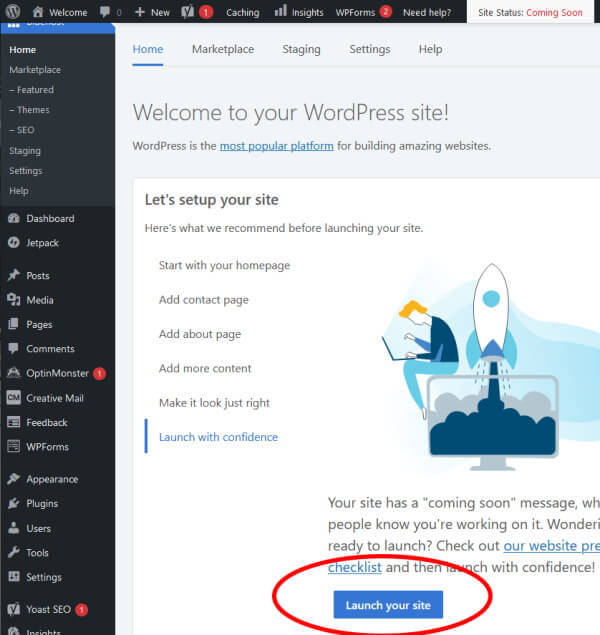
When you are ready to make your blog public for the first time, just click “Home” at the top left of the menu in your WordPress dashboard, and then click “Launch with confidence”. Click the blue “Launch your site” button to remove the placeholder page and launch your blog.
Congratulations! You now know how to start your own blog and publish content!
Step 5: Promote your blog
Creating a well-designed blog and writing great content is just the start. In order to get visitors to your blog you will need spend some time promoting it, especially when you first start.
The strategies below will help get your blog in front of more readers. You don’t need to use every strategy – try out a few and see what works well for you.
Alert Your Inner Circle
The very first people who should become aware of your blog are your inner circle. This includes family, friends, and colleagues within your field. Encourage them to become followers, ask them to mention your new blog, and – most importantly – thank them.
Use Social Media

While you don’t want to overdo it, you still want to create accounts with the “biggies” like Facebook, Twitter, YouTube, Pinterest, and Instagram. You should post a link to your newest content on your accounts, but you can also post relevant news and links to other sources that your readers may find interesting. Don’t forget to use hashtags and engage with your followers!
One of my favorite ways to get visitors to my blog is to post links on my social accounts, like Facebook and Twitter. This is great, because not only do your friends see the link, but if your friends share the link with their friends it automatically multiplies your visitors. If you have created high-quality content on your blog then social media is a way for your blog to go viral.
Comment on Other Blogs
Find other blogs in your community and engage with them. Using the comment section, introduce yourself and leave engaging and constructive comments. Many will allow you to leave a link to your blog. After creating relationships with prominent bloggers in your community, you will find yourself within their ranks quickly.
Engage with Your Visitors
When your readers leave comments on your posts, always engage with them. Reply to their comments and questions, give them “likes” and affirmations. When it is obvious that the author cares about his/her community and readership, visitors are naturally encouraged to return.
Collaborate with other bloggers
Become enmeshed in your blogging community by collaborating with respected members of your field. Collaborating includes guest posting, promoting each other’s blogs and products, and regularly interacting through comments and social media.
Post Regularly
Post content regularly. Create an editorial calendar and stick to it. A good blogger posts at least once per week to start. If you have long lapses between posts, your followers will drop off and your growth will be severely hampered. It’s not easy to post on a schedule, but it’s something you absolutely must stick to.
Create an Email List

In addition to getting new visitors to your blog, you will also want to make sure your current visitors are coming back. This is where email marketing plays a big role. By collecting the email addresses of your visitors (with their permission of course), you can then notify them when you post new content on your blog. This keeps people coming back to your blog, which not only gives you more readers over time, it also allows you to build a closer relationship with your visitors.
Email marketing is too big a topic to cover well here, so I created a separate guide to email marketing for those who are interested (hint: every blogger who wants more readers needs to read this guide).
Optimize your blog for search engines
You want your blog to appear in search results as soon as possible.
Google: Sign up for a Google Webmaster account and open the Search Console. To add your blog, click “Add Property” and follow the steps to add your blog.
Bing: Sign up for a Bing Webmaster account and add your blog.
Submitting your blog is the first step in process known as search engine optimization (SEO).
Keep in mind that with a brand new blog your traffic will be minimal to start with. However, this will change over time as long as you continue to add informative and relevant content on a regular basis.
To optimize this process, each page of your blog should include these fundamental elements:
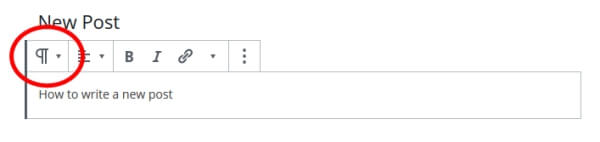
- Header Tags: Section headings and subheadings should be wrapped in header tags. To do this, click on the left item of the block you are writing in and change it to “Heading”. You can then choose from H1, H2, H3, etc.

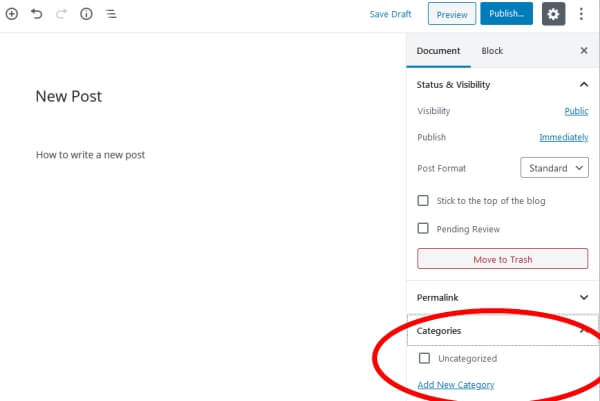
- Categorization: Your content should be clearly categorized into specific and relevant categories. In the post editor screen, click on “Document” on the right menu, and then go down to “Categories” and “Add New Category”.

- Permalinks: Each blog post “slug” is the end portion of the URL. You want to make sure each post has a defined slug and doesn’t end with an article number. You can easily change this in your WordPress dashboard by going to “Settings” -> “Permalinks”. Select the “Post Name” option and click “Save Changes”
There are many more factors relating to consider, such as installing something like the Yoast WordPress plugin, but these are the big ones that will help improve your search rankings sooner rather than later.
For more tips on promoting your blog make sure to check out my in-depth guide to blog promotion.
Step 6: Make money from your blog
Once you have put in the effort of creating great blog content and promoting your blog, making money from your blog is actually the easy part.
Blogs have the potential to be extremely lucrative, but don’t assume that you’re going to start making money in the first week, or even in the first month. It could take six months to a year to start seeing a steady stream of income. Blogging takes work and dedication, but once you develop a large enough audience, there are several methods you can employ to monetize your blog.
Sell advertising space
Once you have a popular blog, advertisers will be hounding you for the opportunity to advertise. The best way to take advantage of this situation is to use Google Adsense. Google finds the advertisers for you and all you have to do is place the Google Adsense code on your blog to start running ads. Google Adsense takes all of the hard work out of the process and just cuts you a check.
I go into the full details of how to set up Google Adsense for your WordPress blog here.
Sell affiliate products
An affiliate program is a commission-based way to advertise. When one of your readers clicks on a link on your blog, they get sent to an advertiser’s site and you earn a commission if they purchase. Affiliate links are a nice way to earn income through the use of product reviews. However, you must remember to disclose that you are an affiliate for the product.
Sell Products and Services
Selling your own products and services directly on your blog is a great way to increase your income. As your blog grows and you begin to see a wide audience, your products and services will begin to sell themselves.
Use the sidebar of your blog to increase the visibility of what you sell using visual images and a link to your storefront page.
Sell digital downloads
Ebooks, video tutorials, and e-courses are the most commonly consumed digital materials sold by bloggers. With little to no overhead and no shipping costs, you can keep the price low and inviting.
If you are extremely knowledgeable in your field, an ebook can practically write itself. Give it a try, you might surprise yourself!
Sell memberships
Another way to monetize is by creating membership options on your blog. This allows you to offer members more exclusive content only available with a paid membership. For example, you could offer unlimited downloads of digital goods, free consultations, a private network or forum where community members can mix and mingle, and private content available to members only.
There are many ways a blog can capitalize on popularity and traffic. Choosing the way you monetize from your blog depends on your goals and the purpose of your blog. Those who are selling services, physical goods, and digital goods, for example, may not want to participate in affiliate programs where traffic could be lost to another site.
For more information see my full guide to making money blogging here
Need more help?
I hope this guide has answered any questions you had on how to start your blog, but if any of the steps were unclear to you, you can find a more detailed version of each step by using the menu at the top right of this page (or at the bottom of this page if you’re on a smartphone).
More specific tutorials can be found on my blog page. Here are some of the most popular tutorials from my blog:
- How to add custom logos or images
- How to see how many people are visiting your blog
- How to move from WordPress.com to WordPress.org
- How to make a website with WordPress
- How to automatically share your new content on Facebook and Twitter
- How to choose the best website builder
- How to link to other sites from your blog
- How to change text size and color
- How to make your blog private
Contact me if you have any issues at all and I will personally respond to your email.
The step-by-step guide on this site should give you everything you need to get started, but if you run into some issues, or just want some personalized advice, please do not hesitate to contact me at any time. Blogging is my passion, and I would love to talk with you about it!
Blogging FAQ
Still have some unanswered questions about blogging? Below are the most common questions I get about starting a new blog. If you can’t find an answer to your question here, feel free to send me an email via my contact page, or leave a comment below.
Click on a question to read the answer:
What makes a successful blog?
Keep writing, keep interacting, keep engaging, and your blog quickly become one of the success stories. As long as you’re passionate about the subject matter, the sky is the limit.
What do you need to start a blog?
Time, passion, and a clear goal.
Blogging is nearly a full-time operation. A successful blogger commits to posting lengthy and detailed content at least weekly. Promoting the blog must also be done regularly across social accounts and through peer interactions.
Equally important is the passion behind your blog. To come up with great content on a regular basis your blog should revolve around a topic that you are obsessed with. You don’t have to be the leading authority on the subject matter. You only need to possess passion, excitement, dedication, and deeply rooted opinions.
You also need a clear goal in mind. What is the main objective of your blog? Is it to inform the public? To eventually retain paid subscribers? With a clear final objective you can grow a blog that satisfies these goals in the long term.
What should my blog be about?
Answer these questions: What are you passionate about? What do you think about daily? What topic do you annoy all of your friends, family, and co-workers with on a regular basis? What do you find yourself dreaming about? What do you find yourself constantly researching? What do you read about?
If there is a common denominator in your answers to these questions – THAT is what your blog should be about.
Your blog should be about what interests you – what you’re passionate about. And once you begin to build your blog, no matter what the subject material, you will find a community of people who are interested in what you have to say.
How do I find a profitable niche for my blog?
If you know the general topic for your blog, a simple way of making your niche more profitable is by narrowing the niche to eliminate competition.
For example, let’s say you’re passionate about food and you want to start by creating a recipe blog. You’ll be competing with a million recipe blogs. So let’s narrow that topic down to something that is more manageable yet still important to a lot of people. Making the topic of your blog more specific will help to eliminate a lot of competition and elevate your blog results in search engines for more specific queries.
How do I name my blog?
This can ultimately be a fun exercise.
As an example, let’s say your blog will be about custom pet gift baskets. In this instance, let’s list all the main words this blog will be about.

Now let’s list some variant synonyms of these words. Use a thesaurus if need be!
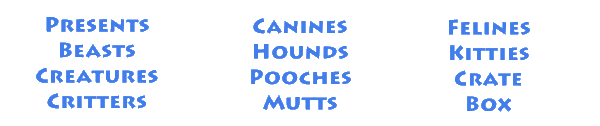
Now list nouns and adjectives that apply to you as the creator.

Now start putting words together, introduce new words, and keep playing around until you come up with a name you like!
 If you are still struggling you can always try using a blog name generator for additional ideas.
What do you do if your domain name is taken?
If the domain name you want is taken and the full web address is your trademarked business name, you can assert your trademark rights and privileges and eventually get this domain handed over to you. It is a lengthy process that will involve lawyers and hefty fees, but as long as the name is trademarked by you, you would likely win the domain name.
If your name isn’t trademarked, don’t attempt to buy the .info or .biz variation of the domain. Instead, try a slight variation of the domain name such as adding a dash between words, or inserting the word “the” or other nominal words.
In some cases, the domain is owned but isn’t being used. Trying searching for it in the browser. If the URL is pointed to a different domain, it isn’t being used, only redirected. You may be able to buy the domain for the right price from the current owner. If the domain is parked, you may also attempt to purchase the domain.
Where is the best place to create a blog?
In the tutorial on this page I show you how to create your blog using BlueHost and WordPress.org. This is known as a self-hosted WordPress blog, and it is what I personally use for this blog and it’s what I recommend to all my readers. When you sign-up with BlueHost you get a free domain name, they will automatically install WordPress (WordPress.org) on your BlueHost account. You can begin blogging as soon as your account is set up. You can easily customize your self-hosted WordPress blog just by following the steps in the tutorial on this page.
How much does it cost to start a blog?
You can make a blog for absolutely nothing. It doesn’t cost one red cent.
But let’s be realistic. If you want your blog to be taken seriously, you can’t just get a subdomain from one of the free blogging sites like Blogspot. You’ll want to pick a custom domain name and register it instead. Domain names cost around $15 per year, on average. So now you’re a whopping $15 in the hole.
But the best way to start your blog is through one of the many web hosting companies. The best web hosting choice is a WordPress hosting account through Bluehost which is $2.75 per month and includes free domain name registration, so your total cost for 1 year is just $33.
These are your main costs associated with starting a successful blog. Of course, you may incur other costs with additional services such as email marketing. As with any business, the biggest expenditure is often advertising, but this would be a cost incurred later on down the road if you choose to go that route.
Do bloggers make money?
Bloggers have the ability to make a full-time income from blogging alone. Some bloggers make hundreds of thousands of dollars. While it isn’t easy to become a highly paid blogger, it is quite possible. As with any business, it takes a lot of hard work and plenty of time.
Many bloggers give up on their project after just a few months. They become discouraged when the money doesn’t come in right away, and it almost never does without an instant and immediate following that comes from being a high profile persona. Therefore, time and patience are needed to reach “influencer” status. Those who make money online are the ones who stick with it.
There are several ways a blogger can earn money:
- Advertisements: As your blog gains traction and brings in a healthy amount of daily visitors, advertisers may pay good money for a well-placed ad on your blog.
- Contextual Ads: With Google Adsense a small piece of code can be placed on your blog that dynamically shows ads related to your content. When one of your readers clicks on an ad the advertiser pays Google, and Google sends you a percentage.
- Affiliate Programs: Affiliate ads are a very popular way to monetize a blog. These ads lead visitors to a product or service on another website. If a sale resulting from a click on your blog is made, you get a commission, and some commissions can be very high. Affiliate programs can be found on individual stores, or on large-scale platforms such as Amazon.
- Sponsored Posts: Advertisers can pay a smaller fee to sponsor individual posts rather than advertising on the entire blog. This is a great method for making money on fledgling blogs.
How do bloggers get paid?
Bloggers are most commonly paid by advertisers. How the blogger is paid varies depending on what type of ads are used.
- CPC: CPC or “Cost Per Click” ads generate revenue simply through clicks. CPC ads are generally highly targeted and rotational. Ads appear on specific blog posts and are related to the content of that post. The number of clicks you generate, which trends upward as your traffic increases, will ultimately determine the amount you are paid.
- Flat Fee: If a blog’s traffic is high, advertisers may pay a monthly flat fee for ad space on the blog’s website. That ad space could appear all over the website, within a section, or just a few pages. The money comes directly from the advertiser.
- Commission: Ads from an affiliate network use affiliate links. These links track visitors that come from your blog to the advertiser’s site. If a purchase is made by a visitor who originated from your blog, you receive a commission.
Should I start my blog on WordPress?
If you’re new to blogging and you don’t have much experience with HTML or coding, then yes – self-hosting a WordPress blog is the best choice for you! When it comes time to choose a blogging platform, the pros turn to WordPress. And even though WordPress is used by millions of smaller blogs, it also powers many of the biggest sites on the internet. In fact, WordPress is the most popular CMS (Content Management System) in the world with over 75 million blogs and websites currently using it. And there are many reasons why:
- Easy to Use: WordPress is remarkably easy to use. Theme customizers help to easily design your blog, change colors, and add images. Once your design is complete, all you need to do is write your content. The internal blog editor records your posts and displays them for you.
- Blog Anywhere: As long as you have Internet access, you can edit your WordPress blog and write new posts. WordPress provides you with an administrative backend where you may log in and work on your blog from anywhere in the world using a PC, Mac, tablet, or smartphone.
- You Don’t Need To Know How to Code: WordPress gives you easy tools to set up a blog that looks stunning without knowing a single line of HTML code or hiring a web developer. This makes WordPress a great option for those who don’t want to deal with technical issues.
- Built-in SEO: Google favors blogs built with WordPress. The out-of-the-box SEO (Search Engine Optimization) which comes packed with WordPress delivers impressive results over time in search engines. This translates to more readers for your blog.
- Free Themes: The WordPress CMS is connected to a repository where thousands of free themes (blog layouts) are available to browse and upload. Directly from the backend of your blog you can browse a multitude of themes with varying styles and functionality. These free WordPress themes can be installed with one click, and then easily customized by a total beginner.
Is WordPress free?
Yes! A self-hosted WordPress blog is a open-source, which is completely free. And there are two different WordPress options, both free, but COMPLETELY different, which you should be aware of. Choosing between them is one of the most crucial decisions you will make.
WordPress.org: This option is completely, 100% free. WordPress.org is the blog platform I show you how to use in the tutorial on this page. While it is completely free to download, it doesn’t run on its own. You will need a web host (see the step-by-step guide) and you’ll also need to buy a new domain name. Because you need your own web hosting plan, this option is known as a self-hosted WordPress blog. So while WordPress is technically free, there are fees involved with getting your new self-hosted WordPress blog up and running (less than $3 per month).
WordPress.com: WordPress.com is a different platform that lets the user create a free blog on a subdomain of WordPress.com. While it does technically let you blog for free, if you would like to enable some basic options, or have your own domain, you will have to upgrade your account to a paid plan. For this and other reasons, I don’t recommend WordPress.com.
How often should I blog?
If your goal is to eventually make money from your blog, you’ll want to start blogging as often as possible – at least once per week. Blogging can be casual if your goal is solely for personal pleasure. But if you’re seeking a large audience and wish to become a leader in your field, blogging weekly is a must.
While frequency is important, it should not come at the expense of quality. Not every piece of content needs be 2,000 words, but all of your posts should be informative and of value to your audience. This is no easy feat. However, if you’re able to stick with blogging on a regular schedule, it will become easier! As with anything else, the more you do it – the more skilled at it you become.
Blogging weekly also helps improve your traffic from search engines, which you can track in your Google Analytics account. When you first begin blogging your latest posts will take time to show up on search engines. As you continue to post regularly you will naturally have more blog posts showing up in the search results, which means more traffic to your blog.
Why do blogs fail?
Almost any blog has the potential to become a success, yet most blogs fail. And there are many reasons why. Here are the most common reasons why a blog fails:
- Giving Up Too Fast – The most common reason why a blog fails is simply that the content creator gives up before his or her blog even has a chance to become recognized. Before you begin a blog, you should realize that most blogs take months and even years to gain traction. It’s quite an investment. If you fail to gain visitors or make money within a month don’t stop! Continue to focus on creating quality content and getting your name out there via social media and networking.
- Intermittent Blogging – When there are long “silent periods” between posts it is difficult to build a solid following. People looking for information on your topic usually want a steady stream of new information to keep them interested. When a blog fails to deliver fresh and updated content people get bored and look elsewhere.
- Poor Content – Some bloggers think they can beat the system with auto-generated content or with duplicate content that is reworded. Readers know fluff when they read it. They know when an article has absolutely no value or when it is simply clickbait. A blog with poor content will never be successful.
- Too Many Ads – Blogs with dozens of ads obscuring most of the content will deter visitors from returning. People don’t come to your blog to be visually harassed by ill-placed, blinking advertisements. They come for information. While ads a good option to monetize, don’t overdo it.
This was super helpful in getting my blog set up. I was able to get the basics done in a less than an hour, and then took my time over the weekend to tweak the design based on your instructions.
I am pleased with how professional it looks, and now I am starting to work on my content plan. Thank you for making this guide!
Very helpful! I’ve been wanting to create a billingual blog (french and english) but didn’t know where to start. Thanks for the detailed information 🙂
Thank you Scott for writing an excellent blog…I’ve been researching to see if blogging is something I want to get into…I am at a beginner level. I am looking for some guidance on where to start and your blog appeared. Very informative post. Thanks once again.
Hi Scott.
Thanks for the valuable information. I’m concerned about the usage of images/licenses.
Can we use creative commons images in our blogs if we are unable to take the photos ourselves? There’s a filter on Google when image searching for “Commercial” and then “Creative Commons” images and wondering which is the safest bet of images to use on a blog. Don’t want to get in trouble!
Hi Jackie,
Yes, I would suggest only using images with a Creative Commons license to avoid any copyright issues. You can easily search for images at search.creativecommons.org
Your tutorials have been really helpful so far in getting my blog up and running. WordPress is tricky without someone to walk you through it. Thanks so much!
Hi Scott. I’ve been thinking about setting up a blog for a while now but didn’t really understand how to go about it. Your guide is really informative and has given me the confidence to give it a go. Thanks a lot 😊
Hi Scott,
Thanks for the great info on starting a blog. I am about to set up a blog that will be mostly political commentary. I also have numerous papers and presentations I have written over the years that I would like to post and make accessible to visitors, apart from my periodic blogging. Do you have advice as to how I can upload them on separate pages?
Hi Peter,
If you have them in PDF format, then I would suggest embedding them into your posts. Here is how to do that: https://www.theblogstarter.com/how-to-embed-pdf-files-in-wordpress-posts/
I just found you on the right time. This is all I needed to start a blog. The very best informative tutorial I have found. Thank you Scott.
Thank you for such helpful content. I’m just starting my blog and your insight is greatly appreciated.
Number one for me in a new blog host is if it has autosave. I currently have a wordpress.com blog which has autosave. But I don’t like the ownership of wordpress.com, so I want to start a new home. Do you know of any blog hosts other than wordpress.com that offer autosave? Thanks, Susan
Hi Susan,
The process I show in the tutorial on this page will help you start a blog that is self-hosted with BlueHost. It has an autosave feature enabled by default.
I have finally started a food blog and I’m excited to learn more from here.
Thanks so much for this info. I am really wanting to start a blog, but I’m concerned about the legal stuff. How do I make sure I am doing everything legal?
Hi Ashley,
You will want to make sure you include a Privacy Policy page on your blog. WordPress provides a Privacy Policy generator by default, so it is very easy to add when starting your blog. Beyond that, just make sure you are being transparent with your visitors if you are collecting any information about them.
You may have specific legal issues depending on the topic you are writing about, but for most people just adding a privacy policy page is enough.
This is wonderful! thank you so much for your helpful advice! I am going to try to do my first blog!
Hey Scott. I always wanted to start a blog but never had a clear idea how to do it. After reading this content, I feel so confident that I would want to start writing now. Thanks a lot.
Glad you found it helpful. Feel free to contact me if you have any trouble.
So far Bluehost is good. My friends told me to use them as well. I used another web host before, but now I see that Bluehost is much better than the web hosting I had before.
Hi Scott,
I just barely created my blog and I would like to make it organize by categories. How do I add that to my blog page? Ex: Place (one category), Family (one category), Home (one category) etc.?
Thank you so much for your insightful post.
Hi Ginny,
When you are in the post editor screen of the WordPress dashboard you will see an option on the right-hand side to choose a category for the post you are writing. You can also create a new category for your post in that same place.
Let me know if you have any trouble finding it.
I had a suggestion (from my vascular surgeon, believe it or not) to start a blog. I imagine a bio theme (70 years). How would I protect the privacy of those I mention?
Hi Mike,
The simplest way would be to change their names and remove any other personally identifiable information. You may also want to consider the tips here: https://www.theblogstarter.com/how-to-blog-anonymously/
Thank you… I’ve been having a yearning to write. I am not a writer but when I do especially on my social platforms, people frequently comment that they wished I did it more. I’ve recently decided that I want to start blogging and have been doing tons of research. This is by far the best “how to” I’ve come across. Excited to follow theses steps and give it a try. I appreciate your willingness to be available to those of us ready to give it a GO!
Awesome Shauna! Let me know if there is anything I can do to help.
This is an excellent and very comprehensive tutorial, Scott. One of the best step-by-step how-to’s I’ve seen on the topic. I’ll be recommending it on my newsletter.
Thanks Rick!
Thank you very much
Am starting my blog and what I read was helpful thank you
I would like to first of all say thank you for all the wonderful and great information you sent to all of us and this is very useful to me and I will and have been looking at this for a long time now but because of your information I really feel like I’m ready. Unfortunately I have a few very simple questions that you possibly can answer in a second but I need to ask them because of my lack of knowledge.
I live in Japan and my blog is meant for Japanese and Europeans and Americans and for everyone really and I will probably be doing some translation at the same time so my question is this. is there a different way to registering a blog in Japan or blogging the rest of the world will my domain name be registered to me even in Japan or other parts of the world.
If you have any answers for me please let me know. Yours truly, Yves Gagnon
Hi Yves,
Domain registration applies worldwide. For example, the domain name for this site (theblogstarter.com) is registered to me and can’t be used by anyone else. No matter where you are in the world, when you go to theblogstarter.com this is the site that comes up. I hope that answers your question.
Thank you so much for your blog. I found your explanations particularly clear, concise, and helpful.
I am setting up a blog right now and chose the plan with the lowest up-front cost.
Should I be concerned that the expiration for my basic web hosting is 12 months? Is there any way to alleviate the issue?
Hi Douglas,
You will have the option to renew before it expires. You can also extend your package for a longer duration at any time from your BlueHost account.
Hi
Can you have multiple people belong to one blog
And post at any time or is it restricted to a single blogger only, thank you
Hi Paula,
You can create multiple users for your blog. Just log-in to the WordPress dashboard of your account and then go “Users” on the left sidebar menu. From here you can add new users. You can also give each user different permissions if you so choose. For example, you could be the only administrator of the blog, while still giving other users the permission to write new content.
Hi Scott, can you use the wordpress from your laptop, tablet and phone to write on-the-go?
Yes, you can easily blog from any internet-connected device. For your phone, I would suggest using the WordPress.org app: https://wordpress.org/mobile/
Do I need a privacy policy on my blog if I am just a personal blogger? If so How do I go about doing that?
Hi Shannon,
It’s not strictly necessary if you are not collecting any data about your visitors, but it’s so simple to do that I recommend it for all new blogs. From the WordPress dashboard, go to “Tools” on the left sidebar menu and then click on “Prviacy”. This will take you to the privacy page generator and help you add it to your blog.
Very easy indeed. Thanks Scott. As a web designer, I often get asked how to start a blog. I’m definitely bookmarking this for sharing. 🙂
I would like to thank you for the information on your site. You have included a wealth if helpful information.
This is my first search for how to start a blog, I have learned a lot from your presentation. I have learned a lot, I’m not sure that a blog is my interest or i need something different.
I am 75 years young, and have never met, or talked with anyone who have experienced a lifetime such as I.
I would like to get my story out there for entertainment, and comments from others who may be able to relate.
Thank You for your very informative information. I assure you that I will come back to your site if I decide a blog
would fit my purpose.
Thank you very much for the great education you have served me.
Hi William,
A blog sounds the perfect medium for what you want to do. You can easily write your story and have others comment on it.
Let me know if you have any trouble getting started. I would be happy to assist.
Thank you for this very informative blog. When setting up the comments section of my blog, is it necessary to ask for a piece of personal info such as the email of the address of the person making the comment? If I let people comment anonymously, this may encourage more people to comment.
Hi Jeff,
You can set it up either way. You are correct that you will get more comments if you don’t ask for an email address, but you will also get more spam comments as well.
Fantastic, and very help. Thank you for such a great help and guidance. You made something impossible possible. Thank you from the bottom of my heart.
Thanks for sharing
Can I start a blog with my phone?
Yes, the steps for how to start a blog are the same for phone, tablet, or computer.
Hi Scott,
Very informative post. I am grad student thinking strongly about starting a blog and wanted to know if you could speak to a respectful posting frequency and how many posts are enough before launching?
Can you point me to some form of blog management information? I am trying to determine if this is something I can commit to.
Thank you in advance
Hi Rocky,
When first starting out I suggest posting once or twice a week. After you have built up a solid readership then you can decrease the posting frequency. Some really popular blogs only post every couple of months.
When you first start a blog I recommend launching it as soon as you finish your first post. This gets you started on growing your readership from day one.
Great synopsis Scott!
Great synopsis of a really BIG subject Scott! Good info for those looking to start blogging.
What an excellent blog… I’ve been researching to see if starting a blog is something I want to get into.. I’m retired and do crafts for friends and family. But ,don’t want to be limited to just blogging about that area. I’m also an author (inspiration-Christian) and wanted to know if you can have sections when establishing a blog?
Hi Gale,
Yes, the easiest way to do this is to categorize each post. Your post will then automatically go to the correct category page on your blog.
Hi Scott, This is some great help! But I have a question….
If I start a blog is it considered a “side gig”? Or do i have to register a “Business”?
How would I report my income?
Hi Cheryl,
You can do it either way. Most people just start with it as a side hustle, and then as it grows you can consider setting up a business. It would be best to talk to a tax accountant once you get to that point though.
Hey Scott. I really appreciate the info, however, both you and BlueHost advertise the cost as “monthly.” When I went to sign up, it gave me a total cost which was the total cost for the contract. Before I give my payment information, I’d like to clarify if I’m paying monthly for the service, or if I have to pay a lump sum. Thanks.
Hi Jeff,
Yes, you will pay up front for the full length of your plan. So if you do a 12 month plan then you pay for 12 months up front. You can cancel at anytime and get a pro-rated refund for the unused months on your plan.
Thank you for all of this information. I’m motivated to start blogging. I am confident that things will go smoothly with all the info that you provided.
Thank you Scott. I am so grateful for this enlightening information you have given to me here. I now know how to set up my own blog. But I have a question. Which method of payment does bluehost support when you are paying for the hosting service? And can you choose to pay monthly, or must it be paid yearly? Thanks once again. Please i am expecting your reply.
Hi Victor,
A one year package is the shortest option. BlueHost accepts credit cards or PayPal.
Feel free to contact me if you have any trouble getting started!
Hi, Scott!
Wow! I think this just might be what I was looking for. I don’t do social media. No tweeting, no Facebook, none of that…. But, I know many people that do. I think they can help get my blog out into the public.
A couple of questions – will the basic set up allow for comments? can I prevent users from leaving comments and delete horrid comments?
I am excited and want to be sure I can control some things before I get rolling….
Thanks!!!
Hi Bruce,
Yes, comments are turned-on by default. You have full control over the comments on your blog. For example, you can have comments automatically approved, or you can choose to manually approve only those that you want. Of course, you can also turn-off comments completely if you prefer.
To change your comments setting simply go to your blog dashboard and go to “Settings -> Discussion”
Hi Scott, Thank you. This is very informative. Can you please help me with narrowing down a name and topics please?
Sure, just send me a message through my contact page with more details on the topics you are interested in.
Very informative and easy to follow! I read to the end and then watched video.
Scott thanks, the tutorial was most helpful. It took me a while but I got there in the end. Good stuff. I used the format you show as it seemed good for me.
Hi! Thank you so much for this! Your guide is so thorough that I am working on getting my blog up and running! Quick question: How do you create an email with your domain name? I Googled it, but I don’t see the same options in my side panel. On the WordPress article I read, it says to go to Store > Dashboard > Manage emails, but I don’t see that. Thank you for your help!
Hi Valerie,
Here is a step-by-step guide to creating a custom email address for your blog.
Hi. Thanks for the tutorial.
Can you do this whole process for a blog with your smartphone?
Hi Fay,
Yes, you can do the whole process with your smartphone.
Hi Scott. Thank you so much for this info. I am very eager to make my own blog but really haven’t a clue where to start or what to blog about. Do you have any recommendations on how to figure out my niche? TIA!
Hi April,
The best niche for you is something you have an active interest in. Think of the things you enjoy spending your time doing and/or learning about. Travel, fashion, fitness, and food are all popular topics. Once you figure out what sounds most interesting to you, your job as a blogger is to provide your unique perspective and experience with that topic. For more detailed info check out this post on finding your niche.
Your tutorial was so helpful and you are so easy to follow and you have a very good speaking voice.
Thank you so much for taking the time to have this website, you tube and making yourself available for questions.
Hi Scott
Thank you very much for taking the time to do this. I want to do a blog about fitness and health diet recipes but am not an expert or anything it’s just something i do on daily basis and I feel like I want to start blogging about it even though I know there are tons of fitness blogs out there but I know this is me being me and the routines i go through and I want to know what you think about it. Thanks
Hi Christiana,
A blog sounds perfect for your situation. People enjoy learning about things from someone who is actually doing it, not some armchair expert.
Yes, there are a lot of fitness blogs already, but that is only because there are also a ton of people who want to read great fitness and health content!
Best of luck, and let me know if you need any help along the way.
Newbie question: so what’s the difference between a blog and a website?? Some blogs seem to be “embedded” in a website. Should one create a website first? Then how do you connect the two? Thanks ahead.
Hi Susan,
A blog is a type of website. You are correct, you can have a traditional website and then have a separate section of the site for a blog. If you are looking for a more traditional website you can follow my guide to starting a website here.
If you follow the tutorial on this page you will have a blog. No need to create a separate website first.
Fantastic, and very help. Thank you for such a great help and guidance. You made something impossible possible. Thank you from the bottom of my heart.
Thank you so much for your blog. I have had so much fun setting mine up and it might never have happened without your blog. I particularly found the video very clear, concise and helpful.
Hey. I want a blog but have so many things it’s like to cover…I need help with a name… Could you help me?
Hi Amber,
Sure, just send me a message through my contact page with some more details on what your blog will be about.
Hi. I’m thinking I may have signed up for the wrong type of blog. I’ve just created a wordpress.com personal blog site (ancestry). I’m just starting the site but am getting notifications that to use ANY plug-ins I need to upgrade to a business account (yikes not inexpensive!). Should I have signed up for WordPress.org??
Hi Sarah,
Yes, WordPress.org is what you want. Just follow the steps in the tutorial on this page to create a WordPress.org blog using BlueHost.